Halo Pastures logo, Conscious food for conscious people, over cattle and chickens on a sunlit pasture. Regeneratively raised chickens on our certified organic pastures. Freeport, MN farm, serving the Twin Cities area.
Halo Pastures logo, Conscious food for conscious people, over cattle and chickens on a sunlit pasture.

Regeneratively raised chickens on our certified organic pasturesFreeport, MN farm · Serving the Twin Cities area

Conscious food for conscious people.

What you eat carries the energy of the life it lived. Our chickens live on organic-certified pasture, in open sunlight, eating what their bodies were made to eat. They're part of a healing, regenerative cycle — and so is anyone who chooses them.

Our Mission: To provide health-giving food while helping move the world back toward balance. We aim to make an honest living by feeding people in a way that gives back more than it takes — renewing the land and supporting the health of the animals, plants, and people who depend on it.

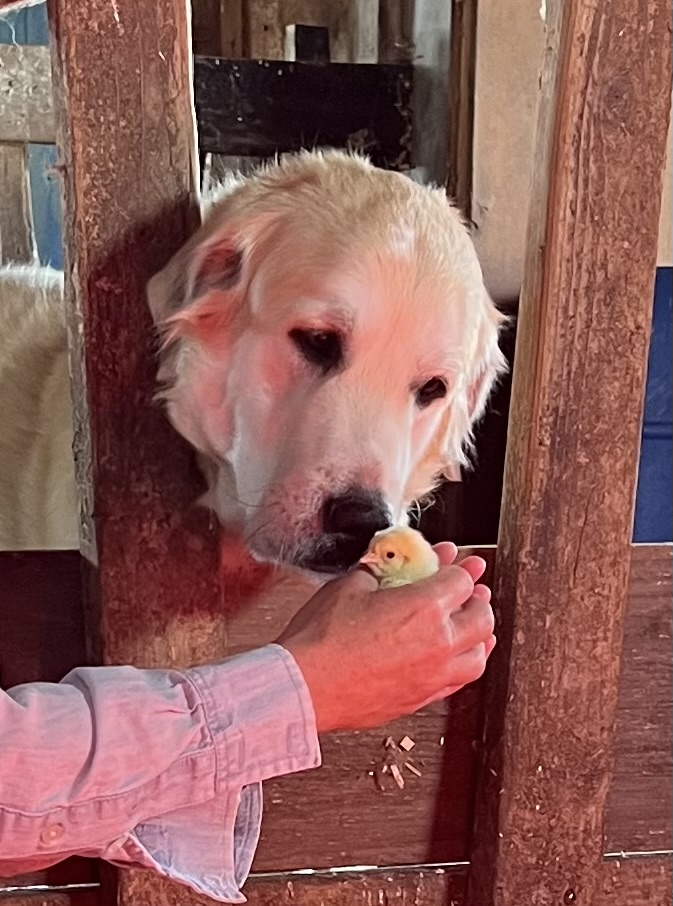
Angel with one of the chicks

Meet Angel

Our Great Pyrenees, greeting one of the flock she's learning to guard. Great Pyrenees have protected livestock for centuries, and Angel is falling into that role quickly and naturally — doing her part, right alongside us, in caring for these animals.

Rooted in Family

ELMER & KRISTAL PHOTO COMING SOON
Ideally with the cattle

Elmer & Kristal

Land & Pasture
"We're third-generation on this land — Kristal and I have farmed it together for most of our lives: row crops, hay, organic beef, and pasture-raised chickens. Regenerative just means finally going all the way with what we already believed in."
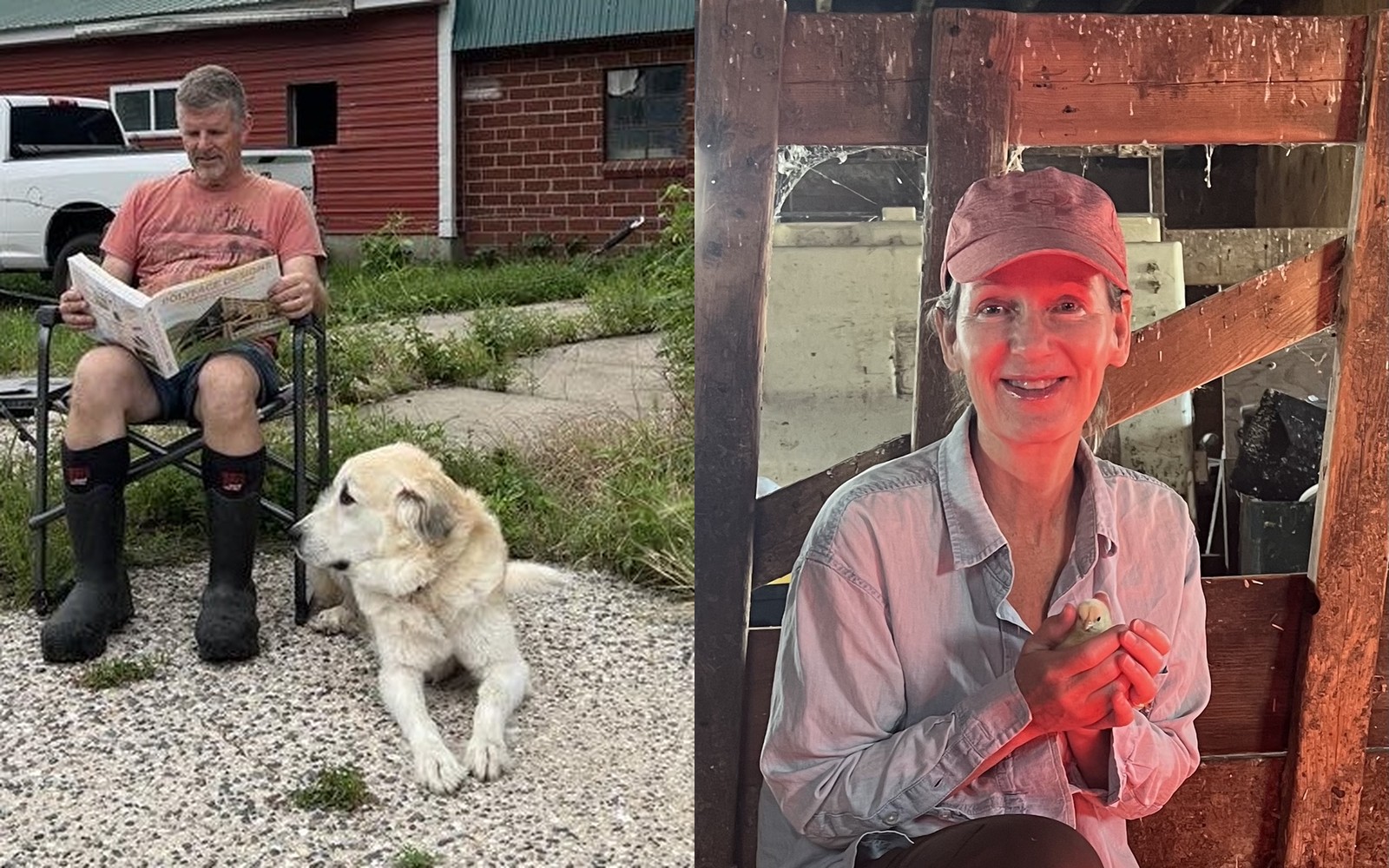
Kevin and Marianne at the farm

Kevin

Systems & Rotation
"I still work my day job on contract — this farm is what I come home to. Nobody's fixing this food system from the top down. It happens one farm, one family, one honest choice at a time."

Marianne

Story & Trust
"I spent years calling on big meat processing facilities. I've seen what really happens behind those doors. This business is how I choose to be part of the solution."

Miracle Underfoot

Nobody notices the cow pies in a field. Yet it's a big part of the miracle of regenerative farming.

A pasture left alone — never grazed, or grazed the same way without rest — grows quiet and thin. The same grasses get cropped again and again, and the soil underneath goes hard and lifeless.

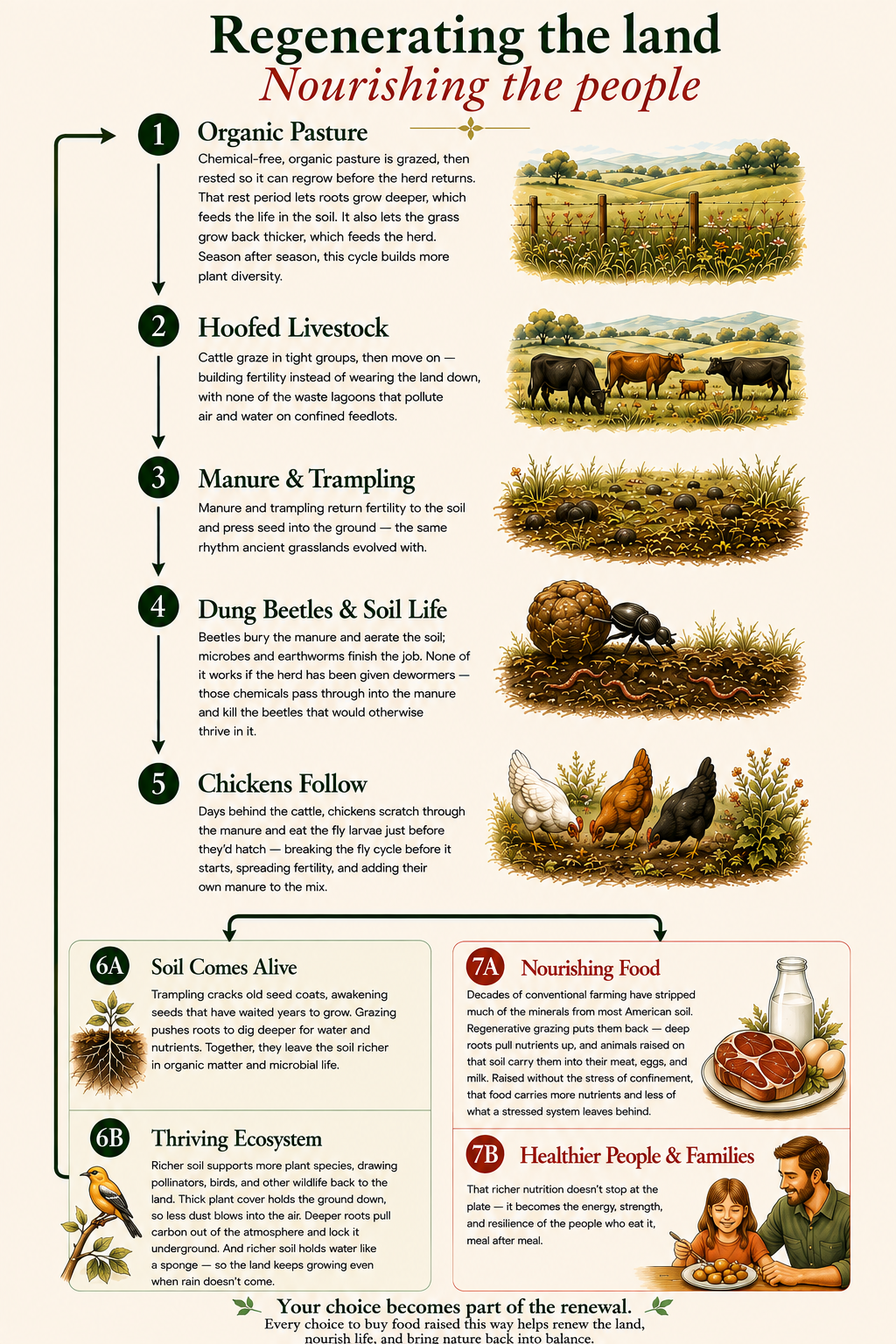
Move animals across that same pasture the way nature intended, though, and the ground starts to answer back. Cattle graze, trample, and leave manure behind — and within hours, dung beetles are already at work, burying it and opening up the soil as they go. Where they've worked, rain stops running off and starts soaking in. That disturbance is enough to wake seeds that have sat dormant for years; native grasses and wildflowers nobody's seen in decades finally break through. Insects move in to feed on them, and birds move in to feed on the insects — one small opening leading to the next. Days later, the chickens follow, scratching through what's left, breaking the fly cycle before it starts, and finishing what the beetles began. They aren't simply the food at the end of the process — they're active participants in it, spreading fertility, eating what the cattle and beetles left behind, and giving the pasture one more push toward a more diverse, living ecosystem.

None of this is engineered. It's what land does when it's allowed to work the way it evolved to — animals, insects, plants, and soil, all in relationship with each other. And it's measurable: more organic matter in the soil, deeper root systems, better drought resistance, cleaner water moving through the watershed, species returning that hadn't been seen on this ground in years.

Livestock aren't a side effect of this system — they're essential to it, and that's true even of the part most people get backwards. There's a persistent story that cattle are simply bad for the land, that a cow standing in a field is something to apologize for. Managed this way, the opposite is true: grazing animals turn grass into manure and deep root growth, and that process pulls carbon out of the air and locks it into the soil, season after season. The problem was never the cow. It was confinement, bare ground, and land left to sit. Cattle and chickens, moved correctly, are part of the miracle of regenerative farming — and that has to be our future, not the exception to it.

Doing this right also means doing right by the animals themselves. Cattle move to fresh ground before they exhaust it. Chickens are moved daily, never confined past what their instincts call for, never crowded past what a life should look like. Honoring the natural behaviors of the animals is part of the regenerative farming system — not an added value, but a built-in one. And the result is life-giving food: meat that carries the health of the land, and the integrity of how it was raised, into the body of the person eating it.

There's one more piece most people never hear about. Decades of intensive tilling, the same crops grown season after season, and heavy synthetic fertilizer use have quietly hollowed out American farm soil — the minerals it once held slowly stripped away, even as yields kept climbing. Food grown in depleted soil can only carry what the soil has left to give. Regenerative grazing is one of the few practices that actually puts minerals back: deep-rooted plants pulling nutrients up from the subsoil, manure and microbial life cycling them back into the topsoil, season after season. It's not just about avoiding harm. It's about rebuilding what was taken.

That's what your reservation actually funds: a small, working piece of that repair.

Regenerating the Land. Nourishing the People. regenerative farming cycle infographic

Frequency Matters

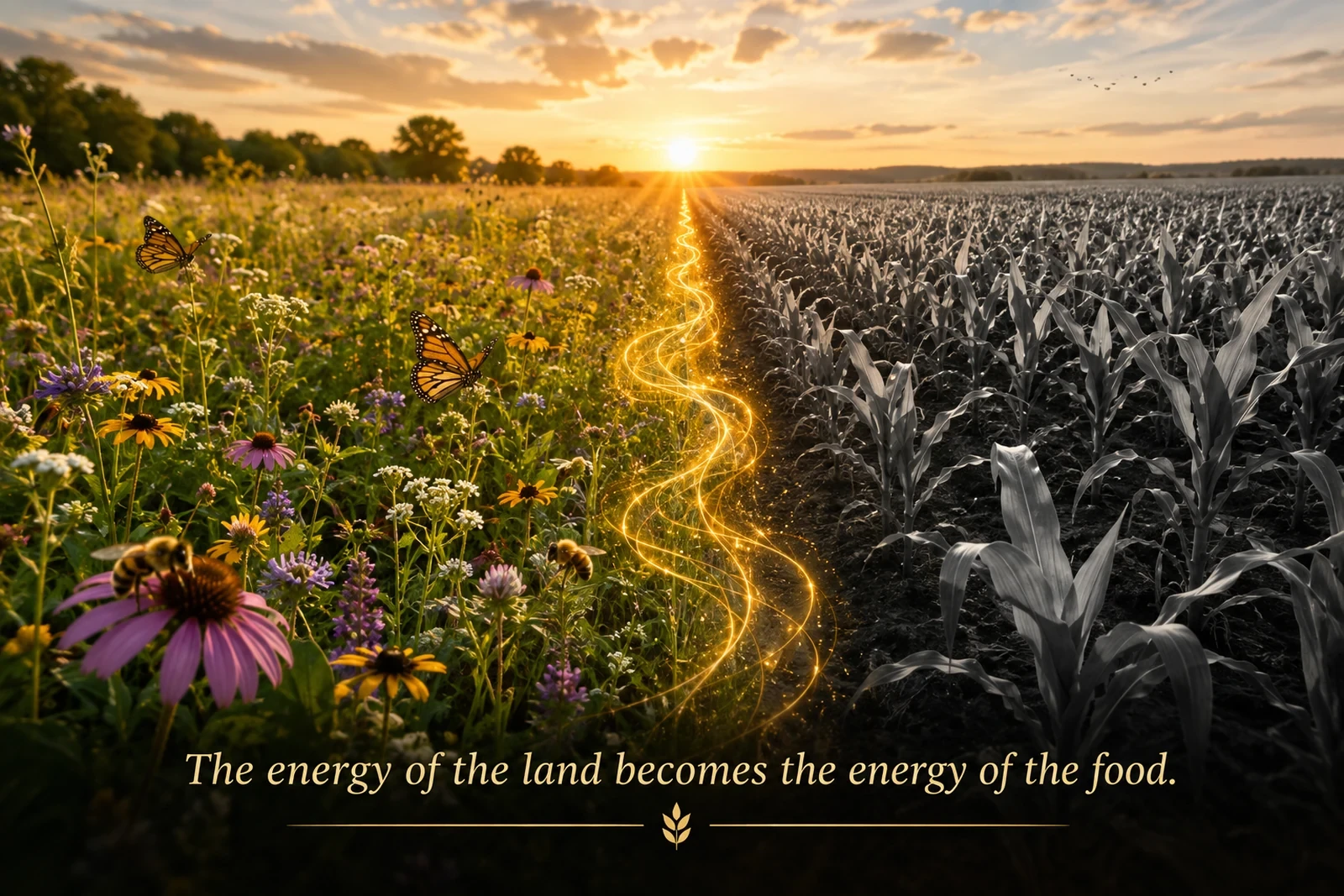
Biodiverse flowering pasture with bees and butterflies contrasted with a monochrome monocrop field, joined by a golden energy line

Health starts in the soil. Diverse pasture plants, active microbiology, clean water, sunlight and open sky — this is what a diverse, lower-stress living system looks like. A chicken raised on regenerative pasture lives within that system: foraging, moving, resting in real sunlight, and growing on a timeline set by its body rather than an artificial deadline.

An animal's environment doesn't just affect how it lives — it affects its physiology. Diet, movement, sunlight, stress and access to pasture all influence the animal that ultimately becomes our food. The conditions matter. The land matters. The life of the animal matters.

Much of today's meat system is built around profit, speed, uniformity and yield — not the health of people, the animals, or the land beneath them. Animals have been selectively bred, intensively managed and fed concentrated, calorie-rich rations formulated to drive rapid weight gain and reach processing weight in remarkably little time. In intensive production, medicated feed and other drugs may be used to control diseases that thrive under production conditions. Accelerated growth can cause serious biological issues: leg, cardiovascular and metabolic problems are well documented, and animals can die before ever reaching slaughter.

The economics can tolerate those death losses. The calculation is whether enough animals reach market weight, fast enough and cheaply enough, for the system to remain profitable.

We've become extraordinarily efficient at producing pounds of meat quickly. But efficiency is not a measure of good food.

At Halo Pastures, we start with a different equation. The health of the soil, the diversity of the plants, the well-being of the animal and the quality of the food are all parts of the same living system.

Call it frequency, if that word helps — the coherence of a living system. Or simply call it biology working the way it was designed to.

When you eat that meat, you're not only taking in protein. You're eating food produced by a particular soil, diet, environment and way of life. Food carries the story — and the biological imprint — of the system that produced it.

You are what you eat may be an old saying, but there is something important underneath it. Conscious food for conscious people means choosing food whose whole history you'd want carried forward to your own table.

Farm Life

Photos and short videos from the farm, posted as the season goes — the land, the animals, and day-to-day life at Halo Pastures.

See Farm Life →

Get Your Chicken

Reserve ahead for less — or get chicken available now

or buy chicken now

Questions? See How It Works

How It Works

How do I get my chicken?

Three ways. You choose at checkout.

  • Farm pickup, free, from the farm on the days listed on the order form.
  • A drop site, also free. We meet you in a parking lot at a set time …. Locations and times are on the order form.
  • Home delivery to your door, charged by zip.

Whichever you choose, the exact day, time and place are on the order form and in your confirmation email.

What's the difference between reserving and buying?

Reserving is for birds still out on pasture. You choose how many, pay a deposit of … per bird today, and we invoice the balance once your birds are processed and weighed. Reserving costs less per pound than buying from the freezer. Reserving opens with each new flock. When it's closed, the Reserve form will say so.

Buying is for chicken already processed and in the freezer. You see exactly what's in stock, pick what you want, and pay in full today.

What size bird will I get?

When you reserve, you don't pick a size, because no bird has been weighed yet. We aim to give everyone an average-size bird, bigger than grocery store chicken. On processing day, each bird is weighed and priced by its size in the table below.

…

When you buy from the freezer, the size is already known and you pick it yourself.

What else do you sell?

…

We're actively working on adding beef. Reach out if you'd like to hear when it's available.

How do I pay?

Checkout is handled securely through Stripe — card payment, no account needed. Prefer cash or check? Reach out before you order and we'll set it up.

When will my chicken be ready?

Chicken from the freezer is ready right away. A reserved bird is ready once the birds are processed, currently around ….

How much does delivery cost?

…

Farm pickup and our drop sites are always free; only home delivery is charged, and the rate depends on your zip. You'll see your exact fee as soon as you enter your zip on the order form. Outside our delivery area? Farm pickup and the drop sites are still free, or reach out and we'll see what we can work out.

For a reserved bird, delivery is billed with your balance when your birds are ready.

Is there a minimum or maximum order?

No minimum. The most you can order at once is …, whether reserving or buying. Want more than that? Just reach out and we'll sort it out with you.

Can I change my order after paying?

Need to change your day? Reach out before your scheduled date and we'll adjust it. Same if you miss a drop site window — get in touch and we'll sort out another day.

What if I need to cancel?

Reach out and let us know — we're happy to work with you.

Do you ship out of state?

Not currently — we sell within Minnesota only. Out-of-state family are welcome to reserve or buy as a gift, or pick up in person if they're ever in Minnesota.

What does the chicken actually look like?

Whole chickens, frozen and ready for your freezer. They run larger than a grocery store bird, because they're raised more naturally and over a longer timeline. Their skin ranges from pale to deep yellow, depending on what each bird found in the grass. Store chickens all look alike because nothing about their lives was allowed to vary. Expect some natural variation bird to bird — that's what the size table above is for.

How are the birds processed — and is it safe?

Processed on-farm in small batches under Minnesota's poultry processing exemption. Each bird is processed by hand in a clean, dedicated space, chilled right away and frozen the same day. You're buying from the people who raised these birds, not from a supply chain.

When can I get more?

If the birds have sold out, reach out through the Contact form and we'll let you know the moment reservations open again.

Get In Touch

Questions about pickup, our birds, or anything else — send a message and we'll get back to you directly, or call us at (651) 300-0370.